In the ever-evolving landscape of electronic music, a fascinating niche has emerged at the intersection of technology and creativity: the programming-focused electronic music playlist. This is not merely background noise; it is a carefully curated auditory environment designed to enhance focus, foster deep work, and fuel the intricate thought processes of developers, coders, and programmers worldwide. The rise of these playlists speaks to a broader cultural understanding of how sound influences cognitive function and productivity.
The concept itself is rooted in the idea of "flow state," a term popularized by psychologist Mihaly Csikszentmihalyi. This state of complete immersion and focused energy is the holy grail for programmers, who often need to maintain intense concentration for hours on end. The music selected for these playlists is specifically engineered to facilitate this state. It typically lacks distracting lyrics, favors consistent, often minimalist, rhythmic patterns, and utilizes soundscapes that promote a sense of calm alertness. This is not the chaotic, high-energy EDM of a festival main stage; it is a more cerebral, textured, and purposeful form of electronic music.
Genres like ambient, intelligent dance music (IDM), glitch, deep techno, and certain subgenres of house and trance form the backbone of these collections. Artists such as Aphex Twin, Boards of Canada, Four Tet, Jon Hopkins, and Max Cooper are frequent fixtures. Their work is characterized by complex, layered production, hypnotic melodies, and rhythms that are engaging without being overpowering. The music provides a steady pulse—a metronomic guide for the mind—without demanding its full attention, allowing the listener's cognitive resources to remain squarely on the code.
The proliferation of streaming platforms like Spotify, Apple Music, and YouTube has been instrumental in the popularization of this trend. A simple search for "coding focus," "programming music," or "deep work electronic" yields thousands of results, with playlists amassing millions of followers. These platforms have become digital laboratories where creators experiment with track sequences, BPM (beats per minute) ranges, and harmonic keys to optimize the listening experience for productivity. Algorithmic recommendations then introduce programmers to new artists and tracks that fit their specific focus needs, creating a feedback loop that continuously refines the genre.
Beyond mere entertainment, the science behind this phenomenon is compelling. Research into the Mozart Effect and subsequent studies have long suggested a link between certain types of music and improved spatial-temporal reasoning. While the initial claims were often overstated, a kernel of truth remains. Music with a steady rhythm can help regulate heart rate and brainwave patterns, potentially leading to improved concentration. The repetitive structures common in minimalist electronic music can act as aural scaffolding, organizing thought processes and warding off the mental clutter that leads to distraction.
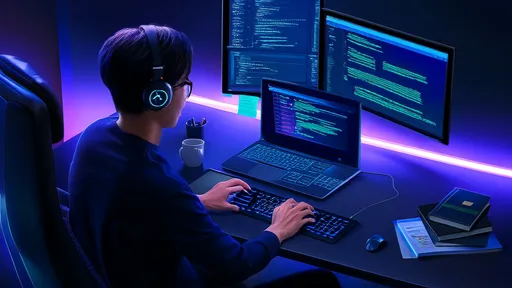
For the modern programmer, these playlists are as essential a tool as a second monitor or a mechanical keyboard. They serve a dual purpose: they create a sonic barrier against the unpredictable noises of an open-plan office or a busy home environment, and they provide a consistent auditory cue that tells the brain it's time to work. Starting a specific playlist can become a ritual, a trigger that initiates a session of deep, uninterrupted coding. This psychological pairing is a powerful aspect of building and maintaining a productive routine.
The community aspect cannot be overlooked either. Online forums, subreddits, and tech blogs are filled with discussions and recommendations for the best focus music. Programmers share their personal "soundtracks," often with detailed explanations of why certain albums or artists work for specific types of tasks, like debugging, architecting new systems, or writing documentation. This communal curation adds a human layer to the algorithmic suggestions, building a shared culture around the pursuit of focused creation.
Looking forward, the trend is likely to evolve alongside advancements in both music technology and our understanding of neuroproductivity. We might see the rise of adaptive music platforms that use biometric feedback—like heart rate monitors—to dynamically adjust the music in real-time, calming the listener during moments of frustration or providing an energy boost during a slog. AI-composed music, generated on-the-fly to match an individual's ideal focus parameters, could become the next frontier. The core goal, however, will remain unchanged: to harness the power of sound to unlock the full potential of the focused mind.
In essence, the programming electronic playlist is more than a collection of songs. It is a tool, a community, and a testament to the unique ways in which art and science converge to solve a very human problem—the need to find focus in a distracted world. For the programmer, immersed in the logical world of code, this music provides the perfect, illogical companion: a stream of sound that organizes chaos and turns the act of creation into a rhythm all its own.

By /Aug 22, 2025

By /Aug 22, 2025

By /Aug 22, 2025

By /Aug 22, 2025
By /Aug 22, 2025

By /Aug 22, 2025
By /Aug 22, 2025
By /Aug 22, 2025

By /Aug 22, 2025
By /Aug 22, 2025
By /Aug 22, 2025
By /Aug 22, 2025

By /Aug 22, 2025
By /Aug 22, 2025
By /Aug 22, 2025

By /Aug 22, 2025

By /Aug 22, 2025

By /Aug 22, 2025

By /Aug 22, 2025

By /Aug 22, 2025
